


I recently saw a chart that shocked me.
Like, it forced me to stop what I was doing and take the time to understand it.
Here it is:
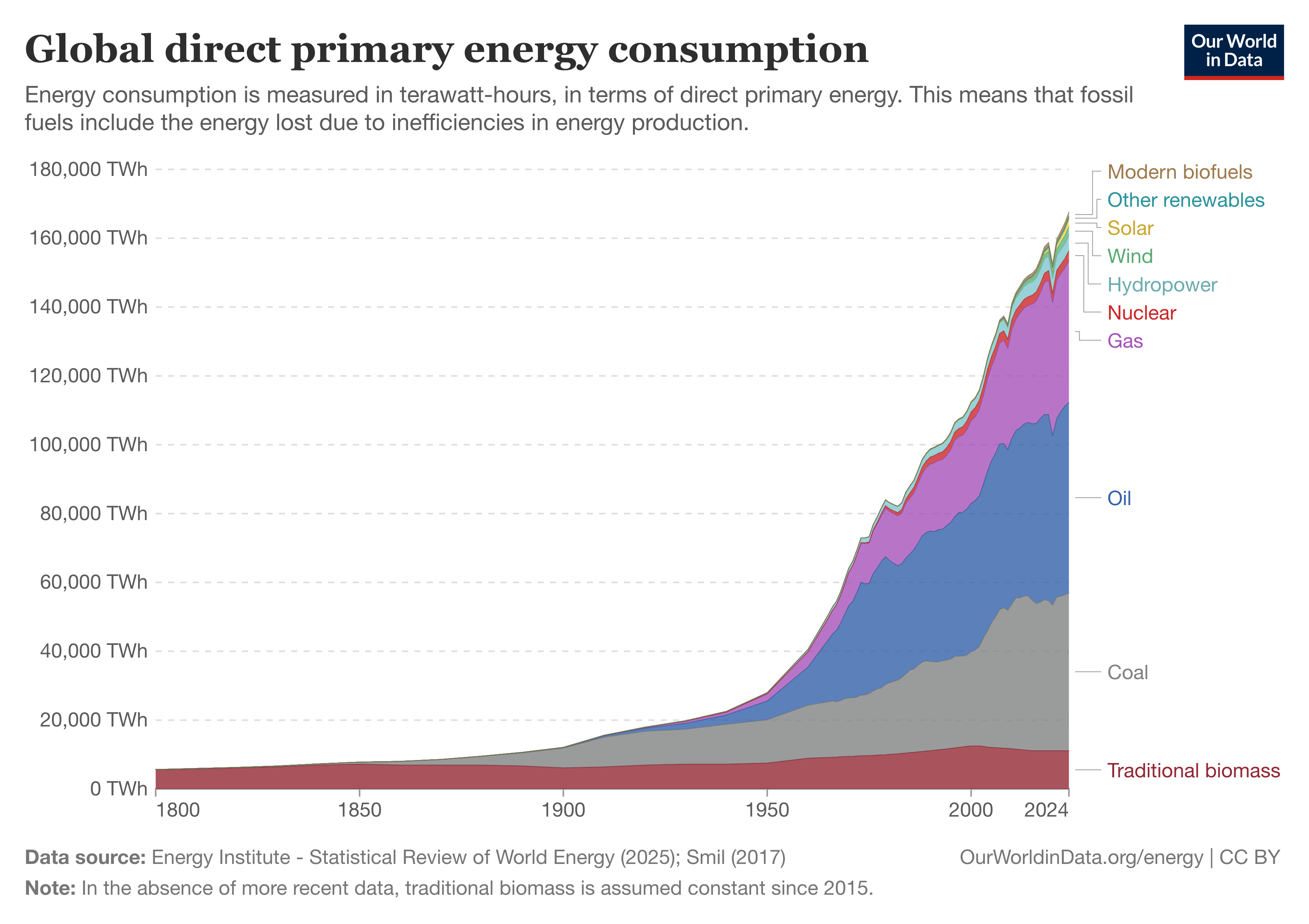
What jumped out at me wasn't the huge unequal distribution of renewable energy in relation to fossil fuel consumption (while that’s worth going into, let's leave it as a topic for another day).
What truly stood out to me was the massive upward trend in total global energy consumption per year, especially since the 1950s.
And to make this spike even more striking, keep in mind that total energy consumption prior to the graph’s beginning has been estimated to be less than 1800 levels.1
So, if we zoom out and look at the entirety of human history, we’re left with a flat-line of global energy consumption followed by an extremely recent exponential spike.
We’re looking at the most hockey-stick growth graphs imaginable.
My immediate conclusion to this was maybe what you’re thinking — “this is completely crazy” and “this cannot be sustainable.”
We cannot ignore that global energy consumption has increased 30-fold in just 200 years.
And so I looked into it.
My first step was to take into account population growth over the same time period:
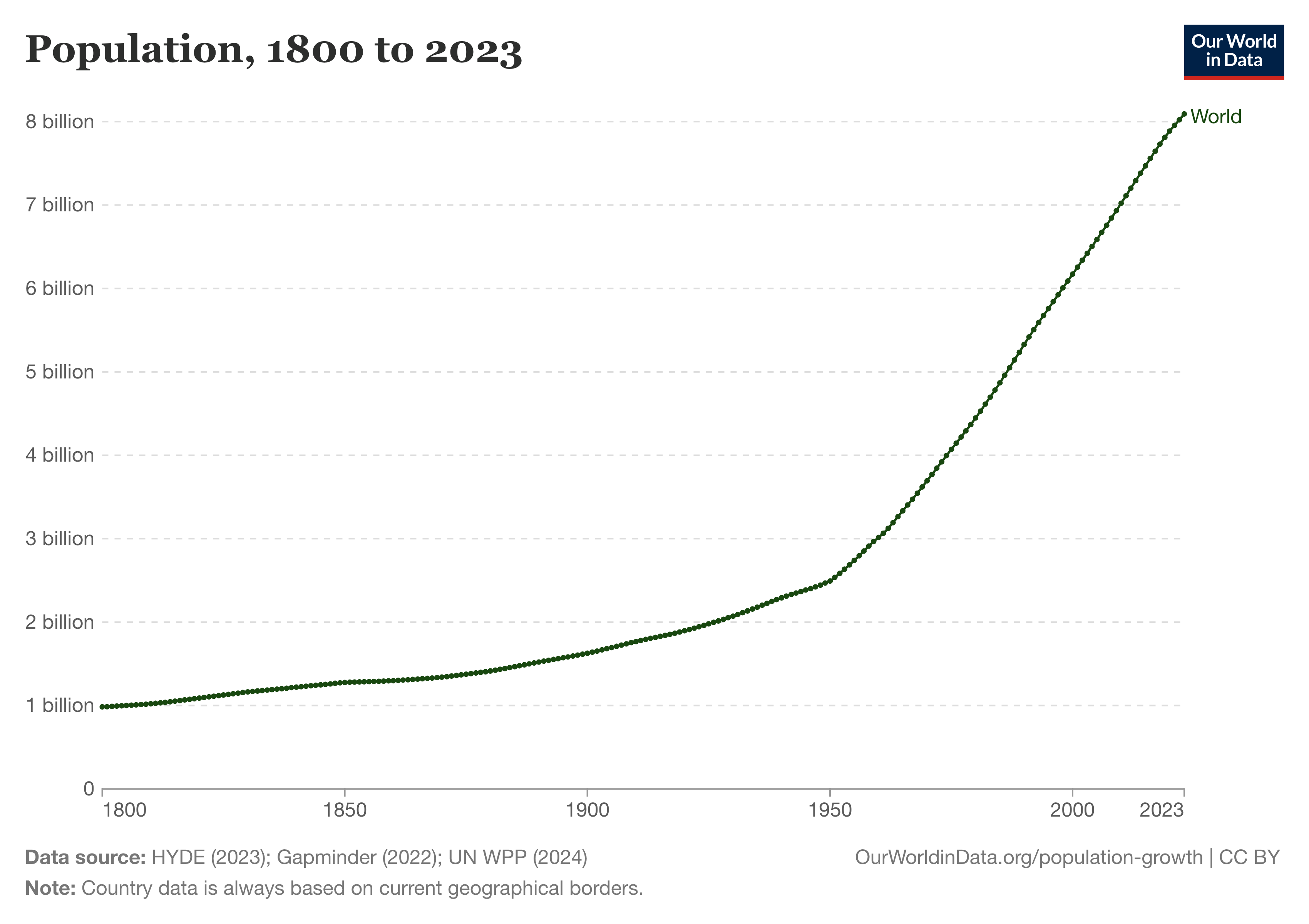
As you can see, population growth has gone from 1 billion in 1800 to 8 billion today. So it’s little wonder our global energy consumption has increased over the same period.
But has it still increased, even if we take a per capita perspective?
The chart below shows that it does. The average person in 1800 spent 5.8 MWh of energy per year; in 2023? 20.3 MWh.
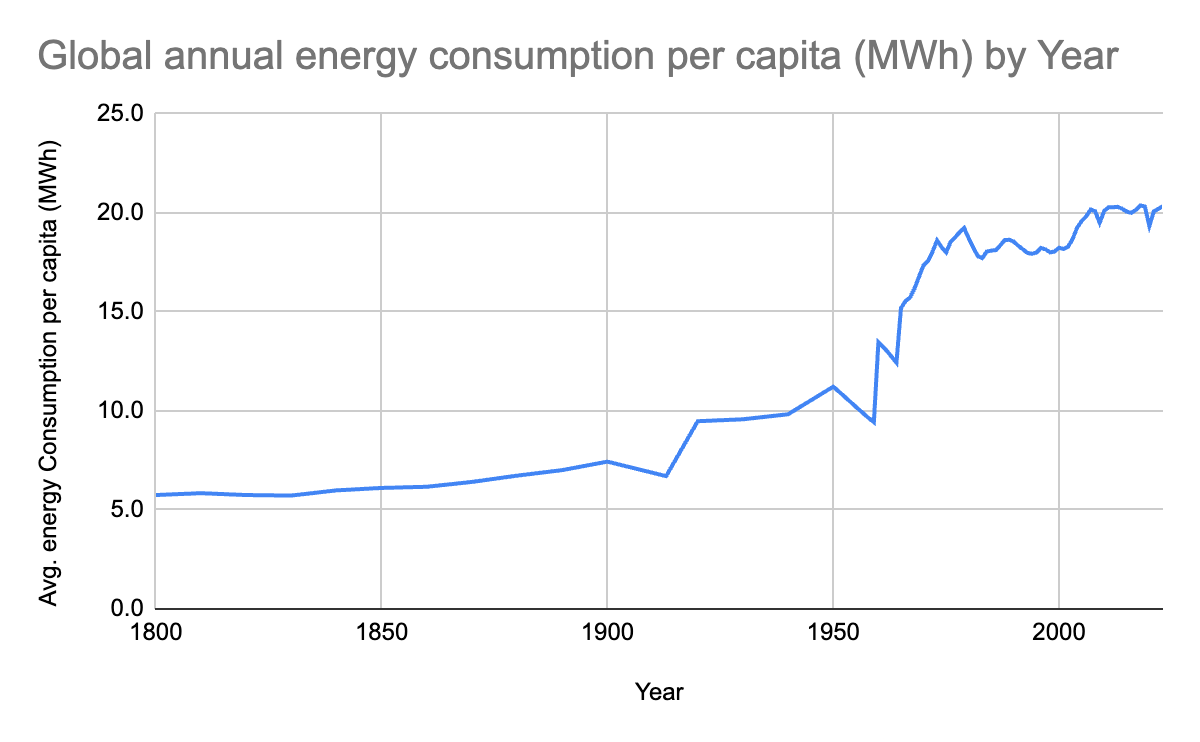
So, even taking population growth into account, we’re still looking at 4x increase of the average global energy consumption per capita over the last 200 years. (And this isn’t even taking into account regional differences!)
This got me wondering what the outcome of all this energy consumption growth has been. As in, what, ultimately, have we been using all this energy for?
My immediate answer was to say: to make life better.
(To me, it should be a given that everything we have done or are currently doing should be in the service of making life better in some way, shape or form).
I’m curious, do you agree with this statement? Or would you say there is another purpose?
For example, what’s your personal energy consumption enabling in your life?
So I wondered if more energy consumption always led to better life outcomes. But how could I see ‘making like better’ in data?
There are many qualitative metrics to choose from but, for the sake of simplicity, I chose to look at life expectancy (as it’s impossible to argue that a life lived to 70 is worse than one ending at 30).
Here’s that chart:
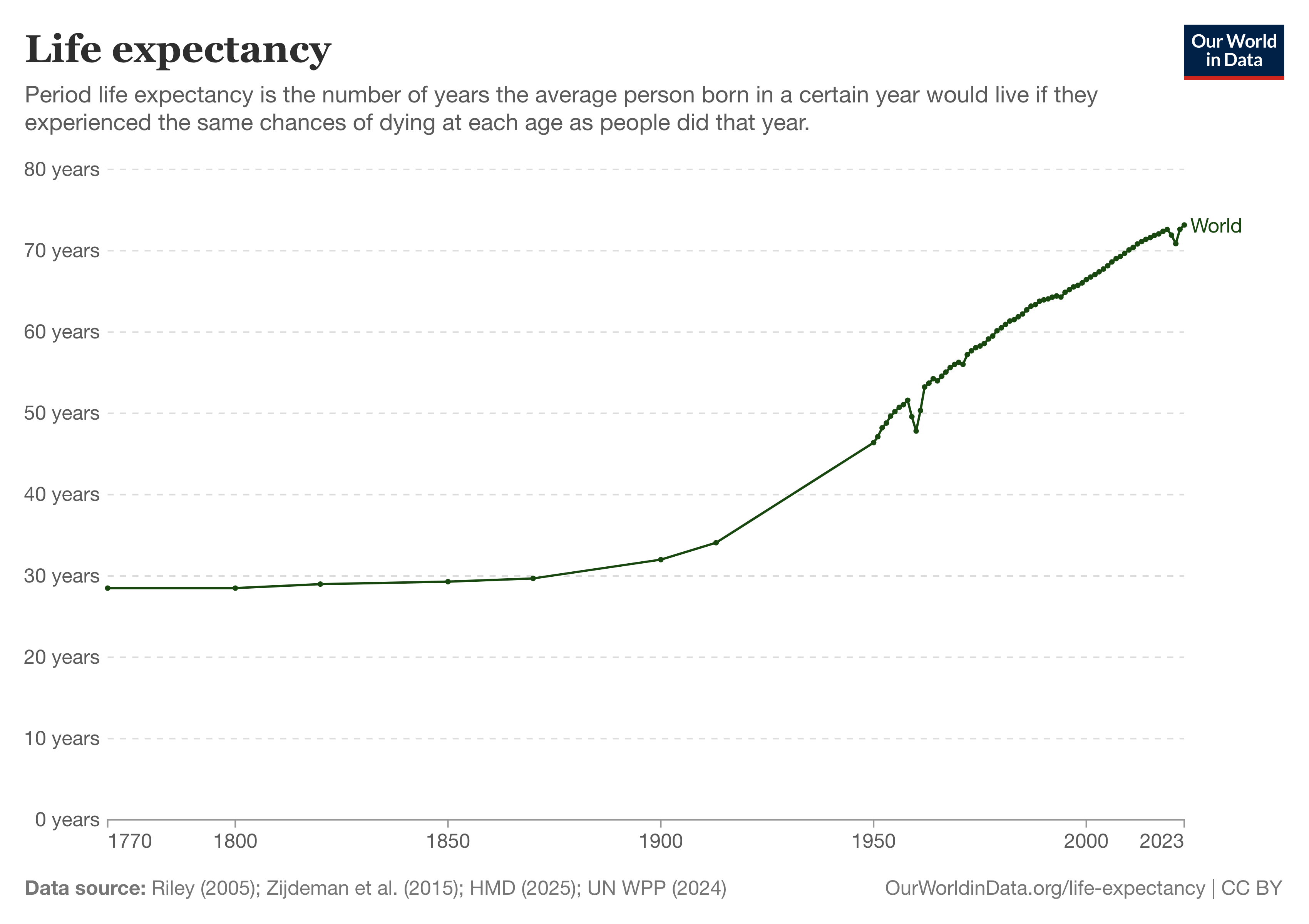
As you can see, even though the charts I’ve shared so far show two vastly different things —global energy consumption and life expectancy — they both follow a similar pattern: a flatline throughout much of history, followed by a sharp upward trend.
So the next logical question: are they correlated?
Given I was looking to compare apples and oranges here, I decided to compare their relative growths from the first year on record, namely 1800.
So I indexed 1800 values to 100 and then plotted both growth curves on the same chart.
Here’s what I got:
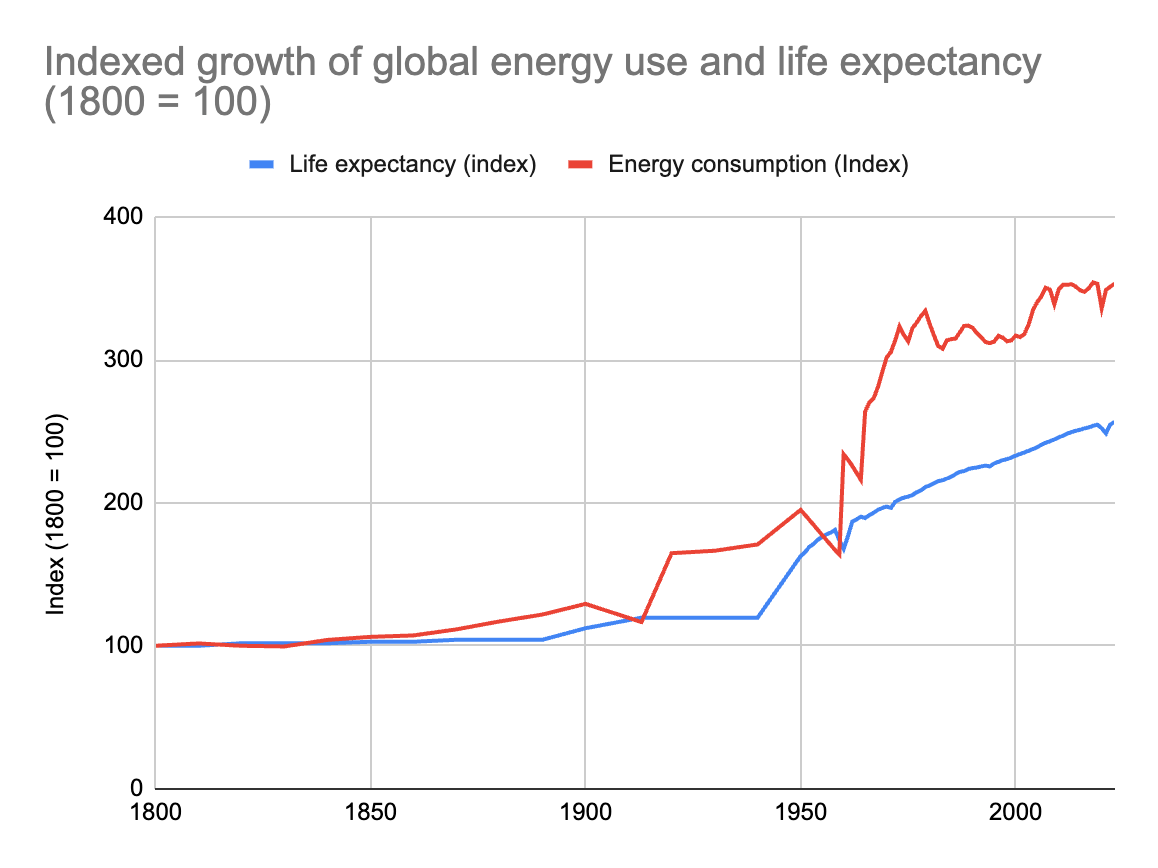
To keep this short, I’m not going to comment in detail on this chart but what I do want to point this out:
As energy consumption has increased through time, there has also been an increase in life expectancy.
And it makes intuitive sense.
Starting in the 1850s, we’ve been using energy to improve things like infrastructure and education, which then improved technological innovation, which consequently improved life expectancy.
This created a virtuous cycle.
Indeed, global life expectancy in 2023 has more than doubled from its 1800 level. And, in the same period, global energy consumption per capita has more than tripled.
Looking at this, my initial assumptions were that we’re seeing diminishing returns on energy consumption when it comes to longevity.
It would make sense that, once the low-hanging fruit of access to clean water, heating, food production and basic healthcare are assured, it becomes harder to increase longevity in proportion to energy consumption.
But using my rudimentary statistical skills, I’m not so sure. Indeed, plotting longevity and energy consumption per capita on a scatter plot returns this:
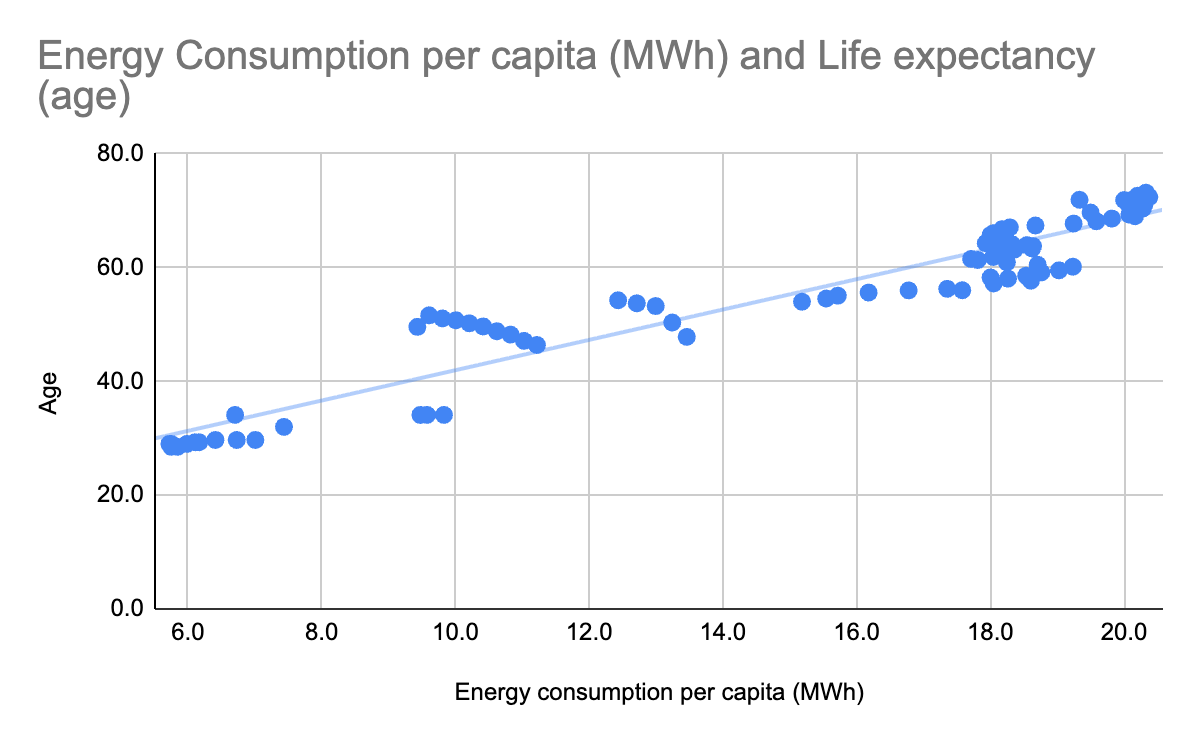
Other than showing there’s very strong correlation between per-capita energy consumption and life expectancy over the observed period (r=0.95), I don’t believe there is statistical proof of diminishing returns on energy consumption with regards to longevity.
If you’re willing to help me out with this particular analysis, do get in touch!
But I digress.
I don’t want to lose sight of my fundamental point:
As shocking as the first chart I showed of global energy consumption is, it carries a lot of hidden implications.
All that growth in energy consumption has served us — for example, by enabling us to live longer.
But, as we approach what must be close to the limits of our biological bodies and the finitude of planetary resources, I’m left with this question:
How is this level of energy consumption serving us today?
What do we get in exchange for it, and, is it still worth consuming more than 160,000 TWh (and growing) of energy per year?
I believe we need to ask ourselves — and I’m talking about the western world here2 — what’s the purpose behind this ever growing energy consumption?
As in, what’s our goal?
Is it still to make our lives better (longer, healthier, happier)?
Or is something else going on?
What you think? Is this something you think about and, if so, what conclusions have you come to?
I’m genuinely curious to hear your perspectives on this so please do share below.
Authors such as Vaclav Smil have estimated historical energy consumption by looking at global population levels x per-capita energy use (see Energy and Civilization: A History).
I’m talking about the western world here because that’s where I’m from. This whole text looked at energy consumption on a global level but I’m very much aware that the western world accounts for a massive proportion of that consumption and that energy consumption per capita isn’t evenly distributed. So the burden of this question really lies with the western world, not the global south.